
Grow food now.
You do not have to wait for the future to start. The tools to automate a real garden exist today, and we help you choose them, set them up, and fit them to your actual space.
FarmBot integration
FarmBot is a nearly ten-year-old open-source nonprofit. You can order a system right now, and we will help you integrate it into your yard, your property, or your food network: siting, power and water, planting plans, and getting it actually running.
- Pick the right FarmBot model for your space and budget
- Plan power, water, mounting, and network before you buy
- Set up planting schedules and automation that fit your crops
- Hand-off support so you can run it yourself
Get a quote
for your space
Tell us about your site, space, and goals through the form - we’ll follow up with a tailored quote and plan.
Inquiries are processed in the order they are received.
Your information stays with us. We don't sell or share it.
Plan your crops
Explore what grows well for your goals and space.
Fast-cycle greens
Can quick-turn crops work reliably in small indoor spaces with minimal intervention?
- Lighting needs for 21–30 day cycles
- Managing watering when access is inconsistent
- Crop selection for low ceilings and small footprints
Local food logistics
How do you move produce a few blocks instead of a few states?
- Delivery models for ultra-short distances
- Storage and handling for micro-scale operations
- Coordination across multiple small growing sites
Educational integration
Can indoor trials serve dual purposes — producing food and teaching STEM?
- Simple data collection students can manage
- Crop choices that deliver quick, visible results
- Documentation practices that support learning goals
Estimate off-grid power
Size a solar setup to run your system off the grid.
Could it run off-grid?
A FarmBot Genesis XL draws only ~0.24 kWh/day - under $2/month on the grid. Model a small solar + battery system below. These are rough educational estimates, not an electrical design.
~0.24 kWh/day - control + motors · 0.24 kWh/day
Rough estimate only. Assumes 25% system losses, 400W panels, and 80% usable battery depth. Real production and cost depend on equipment, weather, shading, orientation, and local rates. Not an electrical design or a generation guarantee - have a licensed professional size and install any system. See our electricity & solar and calculator disclaimers.
The numbers, the tech, and the build
Costs, the systems we evaluate with you, and how a real build phases from first install to a running system.
What's out there - and what it actually costs
These are the systems we evaluate with consulting clients. Knowing the landscape is half the work - vendor maps, real prices, lead times. Numbers are directional and shift as hardware and automation tooling evolve.
What it costs right now
FarmBot Genesis XL
- Cost
- ~$7,995
- Availability
- In Stock
- Lead Time
- Around 2 weeks
- Labor
- ~1 hr/wk
AhaRobot
- Cost
- $1,000–$2,000
- Availability
- Open Source DIY
- Lead Time
- 2-4 Weeks
- Labor
- Under Study
OpenArm
- Cost
- ~$6,500
- Availability
- Assembled or DIY
- Lead Time
- 2-6 Weeks
- Labor
- Under Study
Mobile ALOHA
- Cost
- ~$32,000
- Availability
- DIY Build Only
- Lead Time
- 3-6 Months
- Labor
- Under Study
Garden ($5K–$8K) + robot ($1K–$32K). Actual cost depends on which platforms you combine.
What it consumes
Bed Automation
FarmBot Genesis ($4,995) and Genesis XL ($7,995), the most mature open-source garden automation platform available today.
Visit farm.botLow-Cost Mobile Manipulation
AhaRobot ($1K–$2K), open-source bimanual mobile manipulator with 16 DOF and floor-reaching arms. The most accessible entry point we've found so far.
AhaRobot ProjectResearch-Grade Platforms
Mobile ALOHA (~$32K DIY BOM) and OpenArm (~$6,500), higher-capability systems for bimanual manipulation and teleoperation research. The broader ALOHA line now continues commercially as Trossen AI kits and arms from Trossen Robotics.
Mobile ALOHA (Stanford) ALOHA project & Trossen AIGeneral-Purpose Humanoids
Figure, Tesla Optimus, and others are racing toward general-purpose humanoid robots. Years away and costly for now - but worth tracking, since one machine that handles many tasks could reshape what a small operation can run.
Figure AIWant a custom system map for your space? Get in touch and tell us about your space.
What does an autonomous food system cost today?
Garden automation ($5K–$8K) + mobile robotics ($1K–$32K) depending on platform choices
A year ago, the floor was ~$37K. New open-source platforms like AhaRobot have dropped the entry point dramatically. We're documenting every option as the landscape evolves.
Data based on farm.bot specifications, published Mobile ALOHA BOM estimates, OpenArm docs, AhaRobot paper, ALOHA 2 project materials, Trossen vendor pages, and community sources. Estimates and lead times can change as components and release cycles move. View full disclaimer.
FarmBot Genesis XL
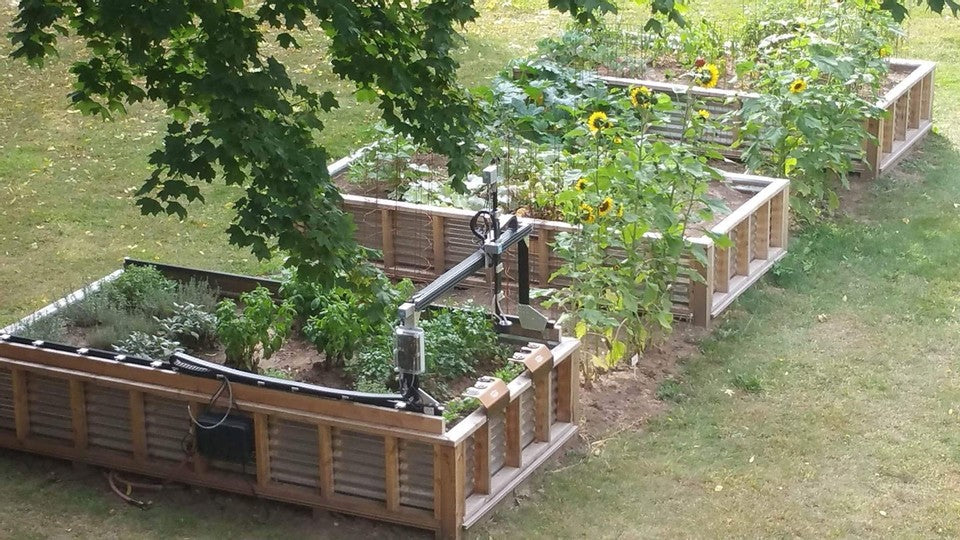
FarmBot demonstrates how precise, open hardware can automate planting and watering on the homestead scale.
Pricing as of March 2026
See system specs →
We're evaluating FarmBot as the bed management backbone for Johnny Autoseed. The full bill of materials, assembly guides, and software are freely available. Follow our findings in Field Notes.
Visit FarmBot Website →AhaRobot
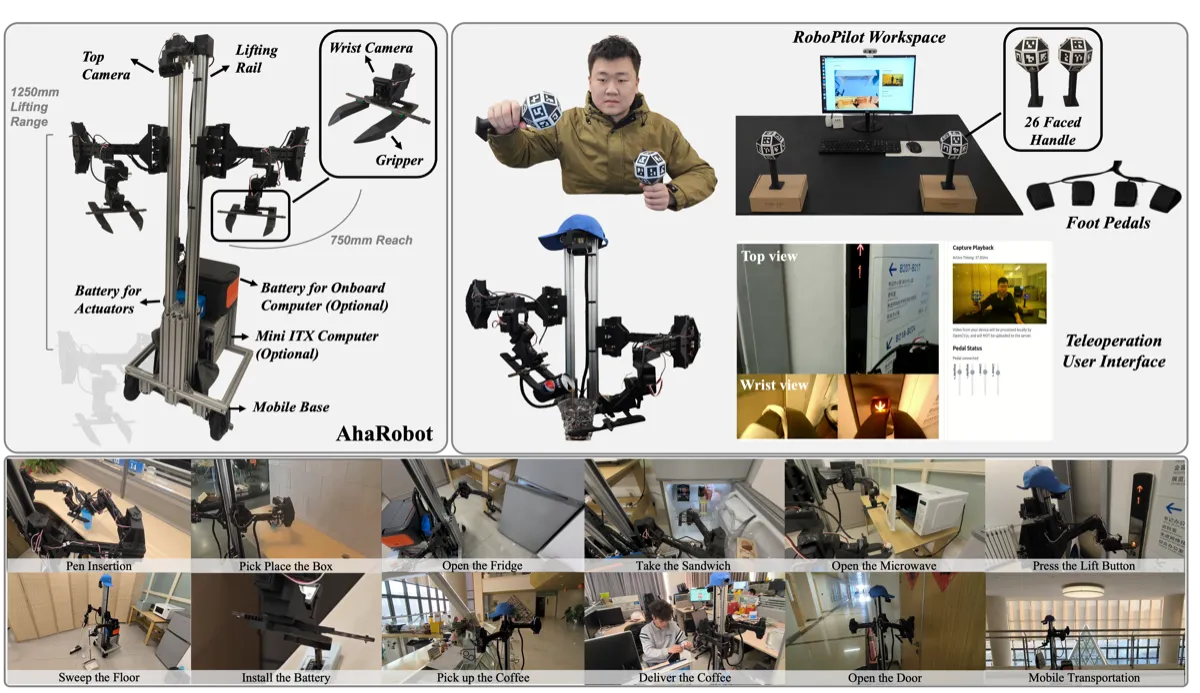
Fully open-source dual-arm mobile manipulator from Tianjin University. At $1,000 to $2,000, it's less than 1/15 the cost of Mobile ALOHA while offering 16 DOF and floor-reaching capability.
Pricing as of March 2025
$1K hardware only; $2K with onboard RTX 4060 compute
See system specs →
AhaRobot uses off-the-shelf Feetech servos, a lifting rail for 1250mm Z-axis reach, and a novel RoboPilot teleoperation system. It reaches the floor (something Mobile ALOHA cannot), making it relevant for harvest and cleanup tasks. Reference paper: arxiv.org/abs/2503.10070.
Read Research Paper →OpenArm (Enactic)
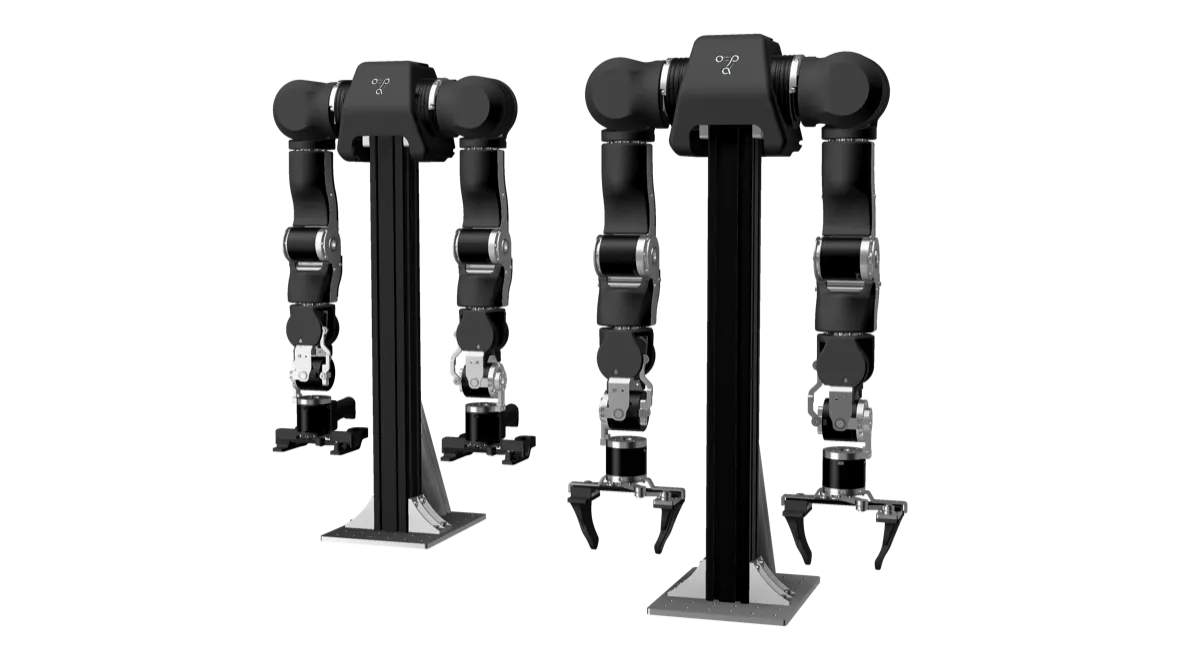
Open-source 7DOF humanoid arm designed for physical AI research. High backdrivability and compliance for safe human-robot interaction at a fraction of commercial costs.
Pricing as of March 2026
Available assembled or DIY from certified manufacturers
See system specs →
OpenArm provides a flexible platform for teleoperation, imitation learning, and real-world data collection in contact-rich tasks. With 1.9k+ GitHub stars and an active community, it's a growing option for manipulation research.
Visit OpenArm Website →Tertill Weeder Bot (Kickstarter)

Solar-powered garden rover from Franklin Robotics that showed backyard weeding automation could ship to consumers before the company wound down.
Campaign completed in 2017
Production ended after Kickstarter backers received units
See system specs →
Tertill used basic height sensors and a spinning trimmer to clip emerging weeds. We keep it as a proof point that compact robots can handle real gardens even if the product is no longer available.
Visit Tertill Site →Mobile ALOHA & ALOHA lineage
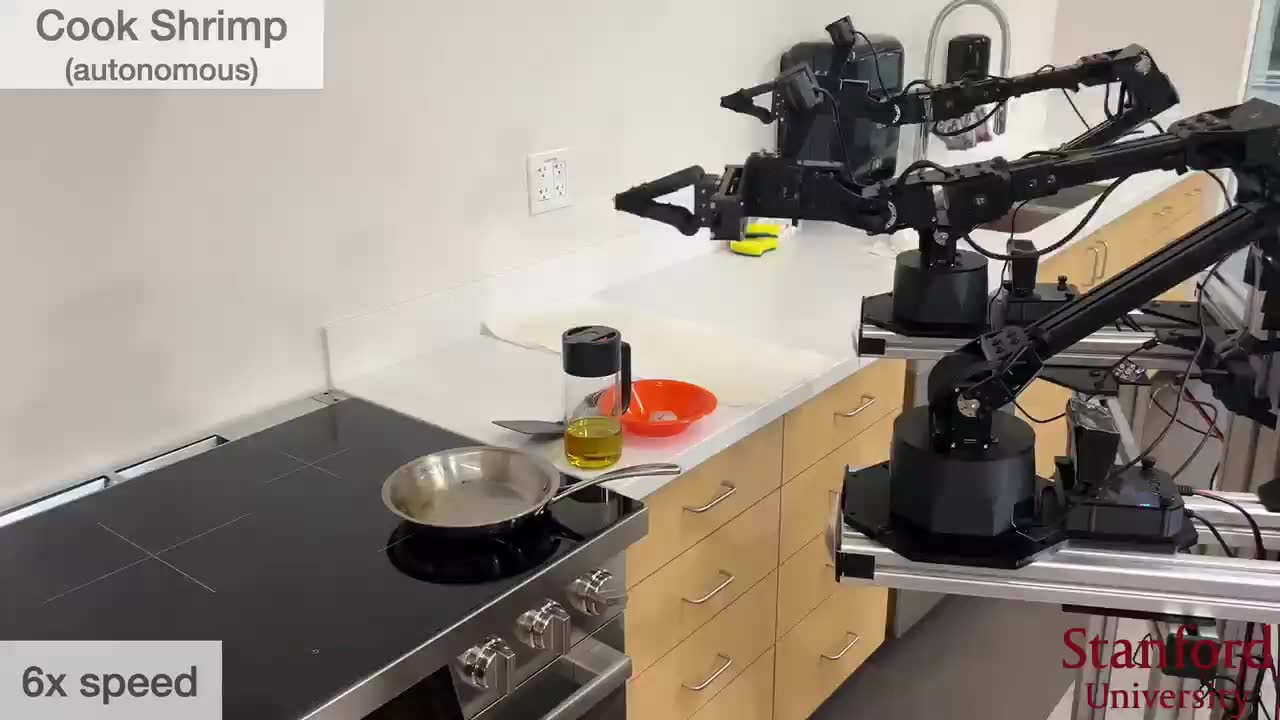
The ALOHA research line (including Mobile ALOHA) showed how affordable bimanual hardware can support imitation learning and real-world data collection. Trossen Robotics now carries that lineage forward as Trossen AI research kits and arms.
DIY BOM estimate; commercial kits vary
See system specs →
Stanford, UC Berkeley, Google DeepMind, and partners advanced the open ALOHA line (ALOHA, ALOHA 2, Mobile ALOHA, ALOHA Unleashed). We track that stack for harvest and kitchen-adjacent tasks, alongside today's Trossen AI hardware ecosystem.
ALOHA project & Trossen AI →ALOHA 2
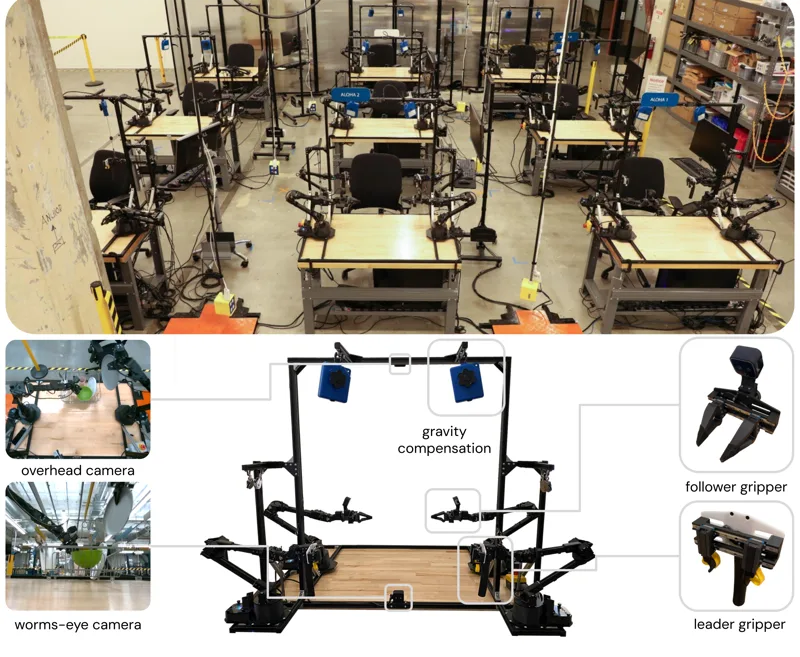
The upgraded open bimanual platform behind much of the recent ALOHA research: better ergonomics, easier teleoperation for data collection, and a clearer path from human demos to policies on real hardware, including work that feeds Mobile ALOHA and ALOHA Unleashed.
Research platform, BOM varies by build
See project site for hardware notes and reproduction guidance
See system specs →
We highlight ALOHA 2 here because the hardware is legible: you can see the two arms, the workspace, and why this family of systems keeps showing up in dexterous manipulation papers. It is not a consumer product pitch, it is the reference rig many papers assume.
ALOHA 2 project site →Figure AI Humanoid

Figure 03 represents the latest in humanoid robotics with advanced AI capabilities, designed for both commercial and home environments.
Company data as of September 2025
Commercial pricing not yet publicly available
See system specs →
Figure AI secured $1B+ in Series C funding at $39B valuation. Their Helix AI platform enables learning from human demonstration, with enhanced tactile sensing and natural language capabilities for household and industrial tasks.
Visit Figure AI Website →Figures blend public datasets and vendor-reported specs; they are directional, not independently audited, and can go stale. Confirm with primary sources before you rely on them. View the full data disclaimer.
Your roadmap - from first call to a running system
No betting the farm on day one. Start small, prove it, then scale. Here’s how we phase a SACSA build with you.
- Free
Start with a call
A free 30-minute intro to see if SACSA fits your space, goals, and budget. No commitment, no pressure.
- Plan
Map the build
Follow-up sessions or a strategy session: a vendor shortlist, a real budget, and a phased plan tailored to your site.
- Phase 1
Automate one bed
Start small - a FarmBot bed with precision drip and a tiny power draw (~0.24 kWh/day). Prove it with real harvests before scaling.
- Phase 2+
Scale & share
Add mobile robots and arms as you grow, then layer in the community-supported model so a few people can feed many.
Data Disclaimer
All estimates, ranges, and comparisons on this site are compiled from publicly available datasets, vendor specifications, and industry research. Johnny Autoseed has not experimentally or independently verified them; they may be incomplete, rounded, inconsistent across sources, or superseded by newer releases.
Treat every figure as directional context only. Confirm material details against primary sources and apply your own judgment before purchases, budgets, partnerships, fundraising, or operational commitments.
Johnny Autoseed is an open research and documentation effort-not a product solicitation, warranty, or offer to sell securities, hardware, or services. Nothing on this site is investment, legal, tax, medical, or other professional advice.
Some pages, prototypes, or drafts may involve AI-assisted tooling. We aim for accuracy, but errors can occur. If something material looks wrong, contact us and we will work to correct it.