Johnny Autoseed

Soil and Circuits

What if robots could grow food in your backyard?

Read our privacy policy.

Featured Technologies

Mobile ALOHA

Stanford-led demos; ALOHA lineage continues via Trossen AI.

FarmBot

Automated CNC garden system.

Tertill Weeder

Kickstarter-funded garden weeding robot (discontinued)

Figure AI Humanoid

Advanced humanoid robot capabilities (set up and tear down).

Seed to Supper

Planting Robots Where Food Deserts Bloom

Exploring Exclusive InnovationFirst Adopter TechnologySuburban ReimaginationAutonomous Supply ChainsNeighborhood CSAsHyperlocal ProductionCommunity Experiments

Millions of people lack access to fresh food.

Imagine if your neighborhood had a fully automated food system? Seed to harvest, harvest to kitchen, kitchen to table.
Less labor. Built for everyone.

That's the vision of
Johnny Autoseed

23.5M
Americans Living in Food Deserts
$9K-40K
Estimated cost per system
3-4 People
People served per system (based on typical FarmBot Genesis XL output vs. USDA dietary guidelines)
75-83%
Toxic Chemical Reduction
96-99%
Metro food desert residents in delivery range
60%+
Potential Savings vs. Organic
24/7
Autonomous Operation

Figures blend public datasets and vendor-reported specs; they are directional, not independently audited, and can go stale. Confirm with primary sources before you rely on them. View the full data disclaimer.

Pathways

How the concept steps from pilot to movement

One automation stack threads through different audiences, starting with showcase installs, spreading through coordinated neighborhoods, and landing in food deserts as shared infrastructure.

Track 01

First Adopters

Enthusiast households de-risk the technology. They absorb early costs, surface real-world friction, and fund R&D through consumer demand.

  • Pay premium for cutting-edge automation
  • Prove reliability, push firmware updates, share data
  • Drive down price curves for future cohorts
ROI: 5-7 years Based on FarmBot Genesis XL + container farm estimates, adjusted for learning-curve maintenance.
Track 02

Neighborhood Networks

Once proof points exist, coordinated blocks unlock logistics synergies and the CSA model.

  • Pool gardens, share harvest logistics
  • Create micro-CSA within walking distance
  • Generate data for grant proposals and pilot programs
ROI: 2-4 years Estimated based on potential for bulk purchasing and shared delivery efficiencies.
Track 03

Food Desert Communities

Once costs drop and logistics are proven, systems reach underserved areas via grants, co-ops, or municipal partnerships.

  • Access fresh produce without car dependency
  • Reduce reliance on dollar stores and fast food
  • Strengthen local supply chain resilience
ROI: 1-3 years Estimated based on grant/subsidy deployment, reduced food transport, and community support models.
01

How Johnny Autoseed Works

This concept combines two existing technologies. FarmBot provides precision planting and watering. Mobile ALOHA-inspired robots handle harvest and prep. Together, they could automate local food production from seed to table.

A

Garden Automation

CNC gantry systems automatically tend raised garden beds

B

Mobile Harvest

Bimanual robots navigate between garden and kitchen

C

Food Preparation

Kitchen-ready assistance for washing, sorting, and meal prep

Bimanual robot preparing fresh vegetables in commercial kitchen
From Garden to Kitchen: Bimanual robots handle harvest processing: washing, sorting, and prep work. This is the "Food Preparation" step in action, bridging the gap between garden automation and your dinner table ready to eat.

FarmBot Lineage

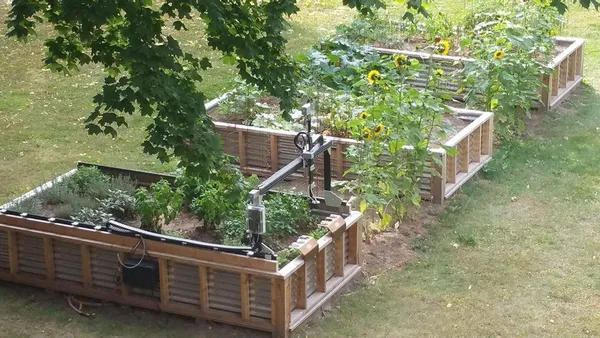
FarmBot automated garden system in action
  • CNC gantry system with sub-millimeter precision
  • Automated drip irrigation per plant
  • Camera-guided pest detection
  • 8+ years, thousands of installations

Mobile ALOHA Influence

Mobile ALOHA robot performing kitchen tasks
  • Bimanual manipulation (two arms)
  • Learn-by-demonstration training
  • Kitchen and post-harvest style tasks
  • Research lineage (Stanford, Berkeley, partners); kits via Trossen AI

Humanoid Robots

Figure AI humanoid robot
  • Full-body humanoid manipulation
  • Natural language interaction
  • Complex multi-step task execution
  • Emerging commercial applications

Tiny Helpers

Tertill weeding robot
  • Solar-powered autonomous weeding
  • Outdoor rugged design
  • Simple mechanical actuation
  • Crowdfunded proof of concept
02

Technology Foundations

Bed Automation

FarmBot Genesis XL

FarmBot gantry system tending raised garden beds

FarmBot demonstrates how precise, open hardware can automate planting and watering on the homestead scale.

Bed Size: 3m × 6m
Precision: ±3mm accuracy
Cost: ~$7,995 USD (XL)

Pricing as of March 2026
See system specs →

We're evaluating FarmBot as the bed management backbone for Johnny Autoseed. The full bill of materials, assembly guides, and software are freely available. Follow our findings in Field Notes.

Visit FarmBot Website →
Manipulation Research

Mobile ALOHA & ALOHA lineage

Mobile ALOHA performing bimanual kitchen tasks

The ALOHA research line (including Mobile ALOHA) showed how affordable bimanual hardware can support imitation learning and real-world data collection. Trossen Robotics now carries that lineage forward as Trossen AI research kits and arms.

Mobility: Omnidirectional base
Arms: 2× 6-DOF manipulators
Cost: ~$32,000 USD

DIY BOM estimate; commercial kits vary
See system specs →

Stanford, UC Berkeley, Google DeepMind, and partners advanced the open ALOHA line (ALOHA, ALOHA 2, Mobile ALOHA, ALOHA Unleashed). We track that stack for harvest and kitchen-adjacent tasks, alongside today's Trossen AI hardware ecosystem.

ALOHA project & Trossen AI →
Historical Example

Tertill Weeder Bot (Kickstarter)

Tertill autonomous weeding robot in garden

Solar-powered garden rover from Franklin Robotics that showed backyard weeding automation could ship to consumers before the company wound down.

Campaign: Kickstarter (2017)
Funding: Fully funded and delivered
Status: Discontinued after fulfillment

Campaign completed in 2017
Production ended after Kickstarter backers received units
See system specs →

Tertill used basic height sensors and a spinning trimmer to clip emerging weeds. We keep it as a proof point that compact robots can handle real gardens even if the product is no longer available.

Visit Tertill Site →
Low-Cost Manipulation

OpenArm (Enactic)

OpenArm 7DOF bimanual humanoid arm system

Open-source 7DOF humanoid arm designed for physical AI research. High backdrivability and compliance for safe human-robot interaction at a fraction of commercial costs.

Arms: 7-DOF bimanual
Design: Backdrivable, compliant
Cost: ~$6,500 USD (bimanual)

Pricing as of March 2026
Available assembled or DIY from certified manufacturers
See system specs →

OpenArm provides a flexible platform for teleoperation, imitation learning, and real-world data collection in contact-rich tasks. With 1.9k+ GitHub stars and an active community, it's a growing option for manipulation research.

Visit OpenArm Website →
Ultra-Low-Cost Mobile

AhaRobot

AhaRobot low-cost bimanual mobile manipulator overview

Fully open-source dual-arm mobile manipulator from Tianjin University. At $1,000–$2,000, it's less than 1/15 the cost of Mobile ALOHA while offering 16 DOF and floor-reaching capability.

Arms: 2× 8-DOF, 1.5 kg payload
Mobility: Omnidirectional, 4–5 hr battery
Cost: $1,000–$2,000 USD

Pricing as of March 2025
$1K hardware only; $2K with onboard RTX 4060 compute
See system specs →

AhaRobot uses off-the-shelf Feetech servos, a lifting rail for 1250mm Z-axis reach, and a novel RoboPilot teleoperation system. It can reach the floor — something Mobile ALOHA cannot — making it relevant for harvest and cleanup tasks.

Read Research Paper →
Bimanual hardware

ALOHA 2

ALOHA 2 dual-arm manipulation platform — hardware photo from the official project site

The upgraded open bimanual platform behind much of the recent ALOHA research: better ergonomics, easier teleoperation for data collection, and a clearer path from human demos to policies on real hardware — including work that feeds Mobile ALOHA and ALOHA Unleashed.

Focus: Bimanual teleop & imitation data
Lineage: Stanford · Google DeepMind ecosystem
Stack: Open hardware + sim + policies

Research platform — BOM varies by build
See project site for hardware notes and reproduction guidance
See system specs →

We highlight ALOHA 2 here because the hardware is legible: you can see the two arms, the workspace, and why this family of systems keeps showing up in dexterous manipulation papers. It is not a consumer product pitch — it is the reference rig many papers assume.

ALOHA 2 project site →
Future Capability

Figure AI Humanoid

Figure AI humanoid robot performing tasks

Figure 03 represents the latest in humanoid robotics with advanced AI capabilities, designed for both commercial and home environments.

Height: Human-scale bipedal
Sensors: Tactile + vision system
Valuation: $39B company (2025)

Company data as of September 2025
Commercial pricing not yet publicly available
See system specs →

Figure AI secured $1B+ in Series C funding at $39B valuation. Their Helix AI platform enables learning from human demonstration, with enhanced tactile sensing and natural language capabilities for household and industrial tasks.

Visit Figure AI Website →

Figures blend public datasets and vendor-reported specs; they are directional, not independently audited, and can go stale. Confirm with primary sources before you rely on them. View the full data disclaimer.

Johnny AutoSeed // Engine v0.1.0
--:--
STAGE 0: RAW LAND
PARCEL.READY
YIELD: 000

Open Johnny Autoseed Engine v0.1.0

03

System Economics

System Specifications

Research Snapshot

Current working assumptions from an open build. DIY first, no checkout page. Numbers are directional estimates and may shift as hardware and automation tooling evolve.

What it costs right now

The Garden

FarmBot Genesis XL

Cost
~$7,995
Availability
In Stock
Lead Time
Around 2 weeks
Labor
~1 hr/wk
Mobile Manipulator

AhaRobot

Cost
$1,000–$2,000
Availability
Open Source DIY
Lead Time
2-4 Weeks
Labor
Under Study
Bimanual Arms

OpenArm

Cost
~$6,500
Availability
Assembled or DIY
Lead Time
2-6 Weeks
Labor
Under Study
Mobile Manipulator

Mobile ALOHA

Cost
~$32,000
Availability
DIY Build Only
Lead Time
3-6 Months
Labor
Under Study
Estimated total system cost $9K – $40K

Garden ($5K–$8K) + robot ($1K–$32K). Actual cost depends on which platforms you combine.

What it consumes

Yield ~400 cups/mo Feeds 3-4 adults annually FarmBot Genesis XL (18m²)
Water -90% vs. traditional gardening Precision drip irrigation
Power <$2/mo ~0.24 kWh/day FarmBot control + motors

Active research, not a storefront

We're evaluating all of these platforms as part of an ongoing exploration into autonomous food systems. As we test, build, and learn, we publish our findings in our Field Notes.

Exploring

Bed Automation

FarmBot Genesis ($4,995) and Genesis XL ($7,995) — the most mature open-source garden automation platform available today.

Visit farm.bot
Exploring

Low-Cost Mobile Manipulation

AhaRobot ($1K–$2K) — open-source bimanual mobile manipulator with 16 DOF and floor-reaching arms. The most accessible entry point we've found so far.

AhaRobot Project
Exploring

Research-Grade Platforms

Mobile ALOHA (~$32K DIY BOM) and OpenArm (~$6,500) — higher-capability systems for bimanual manipulation and teleoperation research. The broader ALOHA line now continues commercially as Trossen AI kits and arms from Trossen Robotics.

Mobile ALOHA (Stanford) ALOHA project & Trossen AI

Follow our evaluations in Field Notes as we document what works, what doesn't, and what's next.

Full System Range

What does an autonomous food system cost today?

$9K $40K

Garden automation ($5K–$8K) + mobile robotics ($1K–$32K) depending on platform choices

A year ago, the floor was ~$37K. New open-source platforms like AhaRobot have dropped the entry point dramatically. We're documenting every option as the landscape evolves.

Data based on farm.bot specifications, published Mobile ALOHA BOM estimates, OpenArm docs, AhaRobot paper, ALOHA 2 project materials, Trossen vendor pages, and community sources. Estimates and lead times can change as components and release cycles move. View full disclaimer.

Machine-Readable

Project Data Snapshot

Structured JSON with system costs, market data, operational metrics, deployment pathways, and risk factors. Built for due diligence, spreadsheets, and team review.

johnny-autoseed-snapshot.json 5.3 KB
{
  "meta": {
    "schema": "johnny-autoseed-snapshot",
    "version": "0.2.1",
    "generated": "2026-03-25",
    "disclaimer": "Directional figures from public and vendor sources; not independently verified. Open R&D and documentation project, not a product offering or professional advice. Verify with primary sources and use your own due diligence before financial or operational decisions."
  },
  "project": {
    "name": "Johnny Autoseed",
    "tagline": "Open research on automation and local food systems",
    "stage": "Pre-prototype — Active R&D / Documentation",
    "website": "https://j
  ...
}

Directional figures from public and vendor sources; not independently verified. Open R&D and documentation project, not a product offering or professional advice. Verify with primary sources and use your own due diligence before financial or operational decisions.

04

Why This Matters

23.5M
Americans in Food Deserts
$5-8K
FarmBot Hardware (Kit)
24/7
Autonomous Operation
Early R&D
Exploring Proven Technologies
60%+
Potential Savings vs. Organic Produce

Figures blend public datasets and vendor-reported specs; they are directional, not independently audited, and can go stale. Confirm with primary sources before you rely on them. View the full data disclaimer.

Food security

Local Food Security

Turn unused land into food production. Less reliance on distant supply chains. More control over what you eat and where it comes from.

As technology improves and costs decrease, automated local food systems could become accessible to everyone.

Spatial reuse

Space Transformation

Any unused land could produce food. Backyards, empty lots, rooftops, community spaces. Automation makes it possible without heavy labor.

From unproductive space to fresh food source. From isolated plots to connected local food networks.

Open foundations

Open Technology Foundation

Built on FarmBot and Mobile ALOHA research. The technology remains accessible. What works at any scale uses the same accessible open technology.

When technology is open and replicable, anyone can adapt it to their needs and context.

Shared knowledge

Community Learning Loop

Every deployment feeds back sensor data, crop results, and maintenance logs so the next neighborhood deployment launches smarter.

Publishing learnings openly keeps costs falling and accelerates access for underserved communities.

Impact Calculator

Estimate the potential of automated food systems in your region

We're documenting every experiment, cost, and tradeoff as we go.

05

Open Research & Collaboration

Open research

Research Collaboration

We're building an open dataset on small-scale food automation — what works, what fails, and what the real costs are. Every finding is published in our Field Notes.

Methodology

1

Assess

Site survey, constraints mapping, and success criteria definition.

2

Design

Co-create a trial protocol matched to available space, budget, and timeline.

3

Deploy & Measure

Install hardware, run the experiment, and collect structured data on yield, cost, and labor.

4

Publish

All results — including failures — are published openly in our Field Notes.

Active Research Domains

Precision Agriculture

Automated planting, irrigation scheduling, soil monitoring, and yield optimization at the raised-bed scale.

Low-Cost Manipulation

Evaluating open-source robot arms and mobile platforms ($1K–$32K) for harvest, weeding, and post-processing tasks.

System Economics

Real-world cost tracking: hardware, electricity, water, labor, and time-to-ROI across deployment scenarios.

Community Deployment

Cooperative ownership models, food-desert siting, and accessibility requirements for shared autonomous gardens.

Target Environments

Residential backyards Community gardens Rooftop installations Indoor / controlled environment Educational institutions Food-desert sites

Interested in collaborating?

We're looking for partners with access to growing space, technical expertise, or community networks. All data is shared openly.

FAQ

Frequently Asked Questions

FAQ

Frequently asked questions

Common questions about Johnny Autoseed, automated farming, and getting started.

Is Johnny Autoseed a real product I can buy?

No. This is a concept and research project that explores what could be possible.

Can I invest or preorder?

Not right now. The goal is to share knowledge publicly. If the exploration shifts toward building hardware, it will be announced.

Why share unfinished ideas?

Because local food systems are a shared challenge. Publishing the research trail accelerates what others can build next.

Where did the budget numbers come from?

FarmBot pricing, current component costs, and documented build experiences. Everything is linked in the resources section.

What makes this different from a traditional farm?

It focuses on backyard-scale automation for high-density environments. The concept explores how accessible robotics could serve neighborhoods rather than industrial farms.

Still have questions? Read the full proposal or get in touch.

06

Essential Reading & Resources

Resources

Essential reading & resources

Curated materials for builders, researchers, and organizers exploring automated food production.

Browse on-site guides, templates, and the proposal PDF →

Technical foundations
Implementation toolkit
07

Toolkits & Templates

08

Field Notes

Folk Technica

Get Our Newsletter

Johnny Autoseed shares updates through Folk Technica - tech for the people, by the people. Warm field notes on practical robotics, food resilience, and tools that extend your capacity.

Get Our Newsletter

Signup is hosted on Folk Technica via Substack.

09

Project Status & Transparency

Documentation Mode · Active R&D

Publishing research as we architect the next build phase

Johnny Autoseed is an educational exploration actively mapping the R&D path toward future prototypes. We're documenting how proven technologies like FarmBot and Mobile ALOHA (ALOHA lineage / Trossen AI) converge, building a roadmap, competitive landscape, and market analysis while we line up partnerships. Expect research notes, reference material, and honest tradeoffs rather than release dates.

What This Means

  • No physical prototype exists yet; everything here is conceptual research
  • No public release timeline is planned until funding and partners align
  • The site prioritizes transparency, data disclaimers, and realistic budgets
  • Updates focus on audits, documentation, and invitations to collaborate

Why Share This?

Food insecurity is critical, and sharing what we learn accelerates solutions. By documenting the concept while it is paused, we aim to:

  • Inspire builders working on similar challenges
  • Demonstrate convergence opportunities across robotics and agriculture
  • Contribute honest data, budgets, and messaging to the broader innovation dialogue

For Builders

Prototype opportunities remain open-ended. Email autoseedsystems@gmail.com if you're inspired to explore alongside us:

  • Start with FarmBot or similar kits in your maker space
  • Document and share your adaptations and research notes
  • Prioritize voices from affected communities when evaluating impact
  • Share learnings with the ecosystem so others can build on them
Open Source

All source code is public.

View on GitHub

Site Map

Game

Autoseed Tycoon — full-screen simulation (hidden route)

Engine

Interactive homestead automation simulator

Budgets

Detailed cost analysis and ROI projections for all three deployment tracks

Resources

Guides, templates, and the public proposal PDF

Developers

Workflows, playbook, and AI-assisted coding notes

Lab

Experiment ledger and WIP notes (noindex)

Spelunker's guide

Onboarding tour of the codebase (renders docs/SPELUNKERS_GUIDE.md)

Privacy

Plain-language: browser-local data vs waitlist/email

Disclaimers

Figures, transparency hub, and clear-site-data tool

Settings

Cookies, Scout progress, game data, and accessibility

Field Notes

Project updates, research notes, and milestones

Resources